Chapter 1 — What Is a Blockchain?
Most digital services depend on a company maintaining a database. Your bank, brokerage, airline, and social network all keep records in systems they operate and control.
A blockchain uses a different model. Instead of one organization maintaining the authoritative record, a network of computers follows shared rules to process transactions and maintain a common state.
By the end of this chapter, you should understand what a blockchain is, why it exists, what people mean by on-chain, how transactions become part of blocks, why blockchain actions generally cannot simply be reversed, and where Vaulta and Blocksfinity fit into the picture.
Start with a familiar model
Consider a traditional application.
You interact with a company, and that company updates the database it controls.
For example, suppose you use an online brokerage and request a change to your account. The brokerage receives your request, checks whether it is allowed, updates its database, and shows you the result.
The company operates the system. Its database is the authoritative record.
A blockchain application works differently.
Instead of asking one company's database to make the change, you submit a transaction to a blockchain network.
The network checks that the transaction follows its rules and, when required, that it was properly authorized. If accepted, the transaction changes the blockchain's shared state.
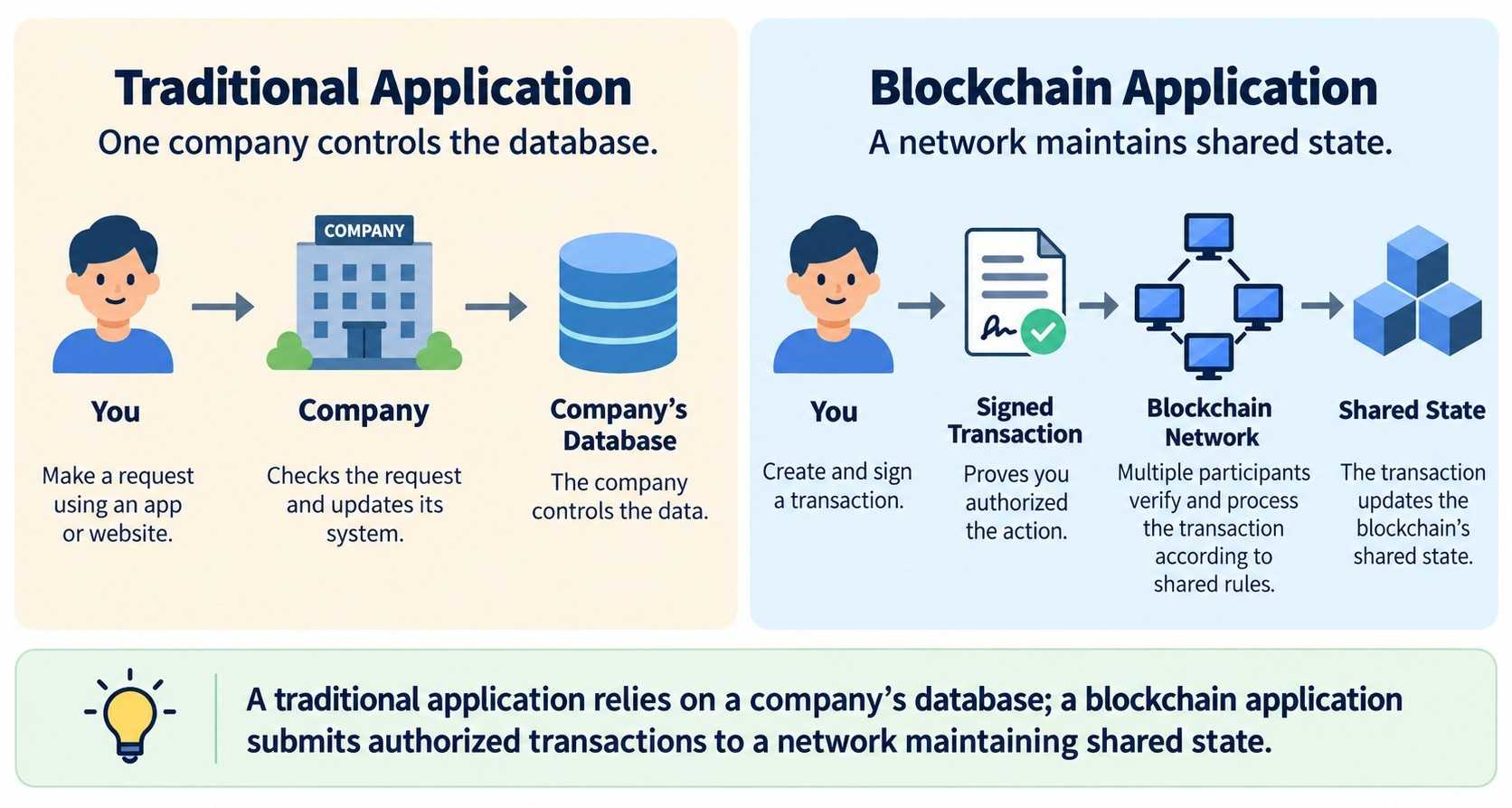
Key idea: A traditional application normally asks one organization to update its database. A blockchain transaction asks a network operating under shared rules to update shared state.
What is a blockchain?
At a beginner level, a blockchain is a shared system for recording and verifying transactions.
Those transactions are organized into groups called blocks. Blocks become part of the network's recorded history according to the blockchain's rules.
The word chain comes from the way blocks are cryptographically connected to earlier blocks. That connection helps make unauthorized changes to previously accepted history detectable and extremely difficult to substitute as valid history.
You do not need to understand the mathematics behind this yet.
The important mental model is:
Transaction
    ↓
Network verifies it
    ↓
Transaction is included in a block
    ↓
Block becomes part of blockchain history
    ↓
Shared blockchain state reflects the result
The state is the network's current recorded condition: which accounts exist, what balances or permissions they have, what data smart contracts store, and other information maintained by the blockchain.
The transaction is the request for a change.
The blockchain state is the result after valid changes have been processed.
Transactions and blocks
A transaction is an instruction submitted to the network.
Depending on the blockchain and the action, a transaction might:
transfer a token;
change an account permission;
interact with a smart contract;
update data controlled by a blockchain application;
participate in network functions.
A transaction is not automatically accepted simply because somebody sends it.
The network applies its rules. For example, it may need to verify that the transaction has appropriate authorization and that the requested action is valid.
Accepted transactions are incorporated into blocks. Those blocks provide an ordered history of what the network processed.
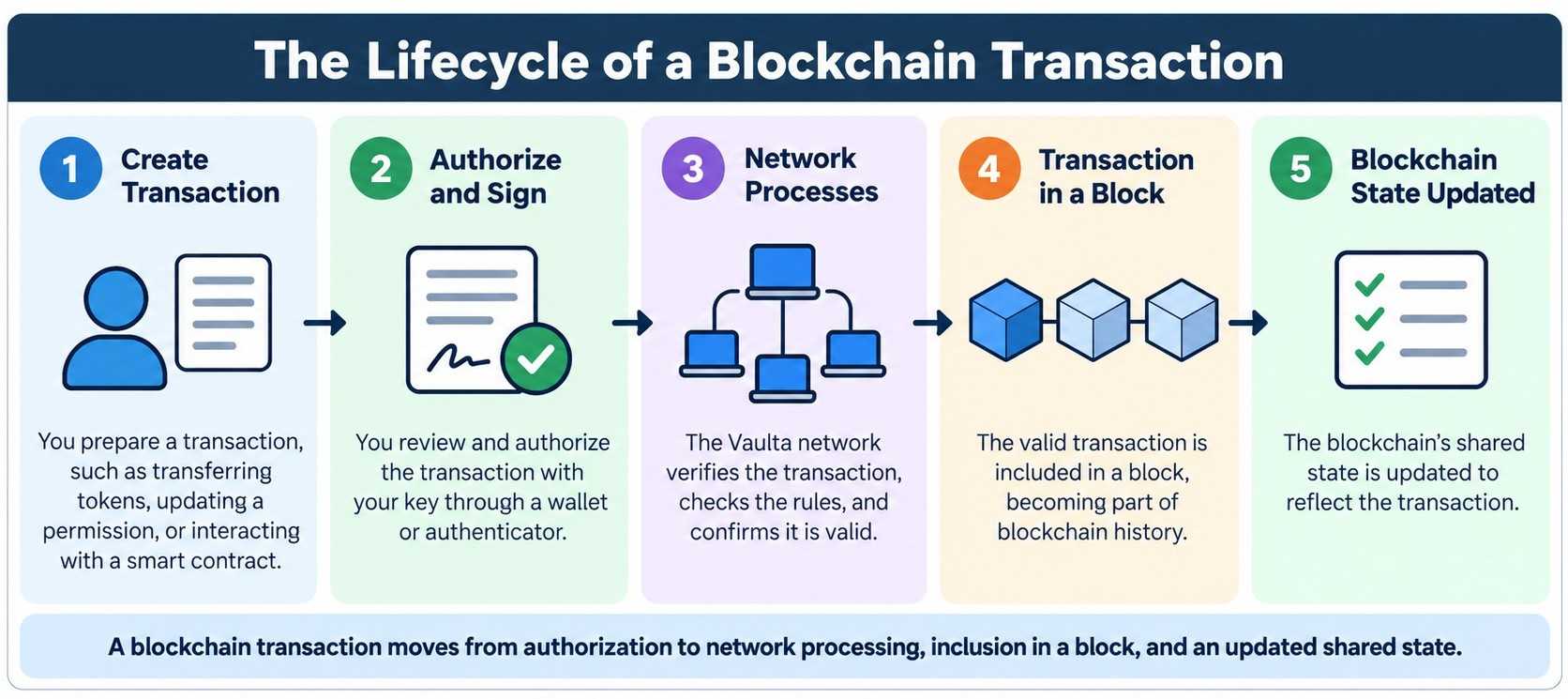
You can therefore think of a blockchain as having two closely related views:
History: What transactions happened?
Current state: What is true now as a result of those transactions?
Why does a blockchain exist?
If ordinary databases already work, why use a blockchain?
The important difference is not that a blockchain is simply a newer database. It is who determines and verifies the authoritative state.
In a traditional application, users generally depend on the organization operating the database.
With a blockchain, multiple network participants follow a common protocol — a set of technical rules — to reach agreement about valid transactions and the resulting state.
This can be useful when participants want a system where records and rules can be independently verified rather than depending entirely on one company's internal database.
That does not mean a blockchain is automatically better for every application. Centralized databases are often simpler, faster to change, and entirely appropriate.
Blockchain becomes interesting when the properties of shared verification, cryptographic authorization, transparent state, digital ownership, or programmable on-chain rules are useful.
What does decentralization mean?
You will often hear that blockchains are decentralized.
That word can become vague very quickly.
For this course, use a simple mental model:
Decentralization means the authoritative blockchain state is not maintained as the private database of one ordinary application operator.
A blockchain network has participants that process, verify, or maintain blockchain data according to agreed network rules.
Different blockchains organize this process differently. They can also have different degrees and forms of decentralization.
So avoid thinking:
"Blockchain means nobody is in charge of anything."
A better model is:
"The network has rules and governance, but the blockchain record is maintained and verified through the network rather than existing only inside one company's private application database."
We will examine how the Vaulta blockchain does this in a later chapter.
What does "on-chain" mean?
When something is on-chain, it means the information or action is recorded as part of the blockchain's state or transaction history.
For example, an on-chain transaction may change a token balance or account permission.
This is different from something happening only inside a website.
Suppose a website allows you to change its visual theme from light mode to dark mode. That preference may simply be stored in the website's database or your browser.
No blockchain transaction is required.
But if you authorize a transaction that changes a Vaulta account permission, that change affects the blockchain itself.
This distinction matters throughout the course.
A website button is an interface action.
A signed blockchain transaction can be a state-changing network action.
They are not the same thing.
Public and verifiable information
One important property of public blockchains is that blockchain information can be independently inspected.
That means you do not necessarily need to trust one website's statement about what happened. Blockchain explorers and other software can query blockchain data and show the recorded result.
For an investor, this is a significant conceptual change from many traditional financial systems.
You may be able to verify activity directly from the network's public data rather than relying solely on a statement produced by one institution.
But public does not mean that you know the real-world identity behind every account, and it does not mean all information should be placed on-chain.
Information written to a public blockchain should generally be treated as potentially visible to others.
Important: Never put passwords, private keys, recovery credentials, confidential personal information, or other secrets into a public blockchain transaction simply because a blockchain application provides a text field.
Why can't a transaction simply be reversed?
In an ordinary application, the company operating the database may have the ability to edit a record directly.
A blockchain is designed differently.
Once a valid transaction has been accepted and finalized according to the network's rules, an interface such as a website generally cannot simply delete that transaction from blockchain history.
For example, imagine that Alice sends a token to Bob.
Alice
  ↓
Transfer transaction
  ↓
Blockchain
  ↓
Bob receives the token
If Bob later sends it back, that does not erase the first transaction.
Instead, there are now two transactions:
1. Alice → Bob
2. Bob → Alice
The second action may economically reverse the effect of the first, but the original transaction remains part of the historical record.
Smart contracts or network rules can sometimes provide their own recovery, cancellation, dispute, or corrective mechanisms. But those mechanisms also operate according to defined rules; they are not equivalent to a website administrator secretly rewriting blockchain history.
This is why reviewing a transaction before signing it should become one of the most important habits.
Key idea: A mistake on a blockchain is often corrected with another valid action, not by pretending the first action never happened.
Smart contracts: making a blockchain programmable
Recording transfers is only part of what a blockchain can do.
A smart contract is a program whose rules are executed on the blockchain.
Despite the name, a smart contract is not automatically a legal contract.
Think of it first as software running under blockchain rules.
A smart contract can define instructions such as:
which actions are allowed;
what authorization an action requires;
how token balances change;
what information is stored;
how participants interact with an application.
When somebody sends an appropriate transaction, the network executes the relevant smart-contract logic and determines the resulting state.
This is what makes blockchains programmable.
Instead of only recording that Alice sent something to Bob, the blockchain can run agreed software that determines what should happen when participants perform particular actions.
We will interact with smart contracts later. For now, remember the distinction:
Blockchain: the network and shared state.
Smart contract: a program executed through that blockchain.
The Vaulta blockchain and Blocksfinity.com
This course will use Vaulta as the blockchain network.
You will also use Blocksfinity Blockchain Explorer and Authenticator to inspect and interact with Vaulta.
Keep those roles separate from the beginning.
You
  ↓
Blocksfinity
  ↓
Transaction or blockchain query
  ↓
Vaulta network
  ↓
Blockchain state
Blocksfinity can provide an interface that makes blockchain information easier to read and blockchain actions easier to prepare.
But the interface is not the blockchain itself.
This distinction becomes particularly important later when you learn about accounts, authenticators, private keys, permissions, transactions, and recovery.
Your understanding should never depend on thinking that an account or asset exists merely because a particular website displays it.
Key idea: Vaulta is the blockchain. Blocksfinity.com is one interface for seeing and interacting with it.
What you should remember
A blockchain is a shared system for recording and verifying transactions according to network rules.
A transaction requests a change; accepted transactions are organized into blocks, and those changes affect blockchain state.
Decentralization means the authoritative blockchain record is not simply the private database of one ordinary application operator.
On-chain means an action or piece of state is recorded by the blockchain, rather than existing only inside a website or private database.
Finalized blockchain transactions generally cannot simply be deleted or rewritten by an interface. Correcting an outcome usually requires another valid action.
Smart contracts are programs executed through the blockchain and make blockchain systems programmable.
Vaulta is the blockchain. Blocksfinity is one of many interfaces for seeing and interacting with it.
Quick Quiz
1. What is the most important difference between a traditional application database and the blockchain model described in this chapter?
A. A blockchain never stores data.
B. A blockchain maintains shared state through a network operating under common rules rather than relying only on one company's private database.
C. Traditional databases cannot process transactions.
D. Blockchains do not use computers.
2. What is a blockchain transaction?
A. An instruction submitted to the network that may change blockchain state if it is valid and authorized.
B. Any button clicked on a blockchain-related website.
C. A group of transactions that has already been included in a block.
D. A block that has not yet been created.
3. Alice sends a token to Bob in a finalized transaction and Bob later returns it. What normally happens?
A. The original transaction disappears.
B. Blocksfinity Explorer edits the original transaction.
C. A second transaction records Bob sending the token back while the original remains in blockchain history.
D. The blockchain automatically resets both accounts.
4. Which statement best describes a smart contract?
A. A legal agreement that is automatically enforceable in every country.
B. A password used to access a blockchain.
C. A company database connected to a cryptocurrency website.
D. A program executed through the blockchain according to defined rules.
5. An investor sees a Vaulta account balance in Blocksfinity. Which mental model is correct?
A. The balance exists inside the investor's web browser.
B. Blocksfinity Explorer owns the balance because it displays it.
C. The relevant state exists on the Vaulta blockchain, while Blocksfinity Explorer provides an interface for viewing and interacting with that blockchain data.
D. Closing Blocksfinity removes the account from Vaulta.
Answer footnote: Q1:2; Q2:1; Q3:3; Q4:4; Q5:3.
Last updated:
Was this article helpful?
Have a specific question about this article?